Our motto here at Interior Archaeology is "Creating Noble Spaces." Noble, in this context, doesn't necessarily mean formal — it just means a space reaches its highest capacity when it's helping its occupant reach theirs. Color is one of the quietest and most powerful tools I have for doing that, and yet it's the thing clients agonize over more than almost anything else. ("Just tell me what white to paint it," they beg. If only it were that simple!)
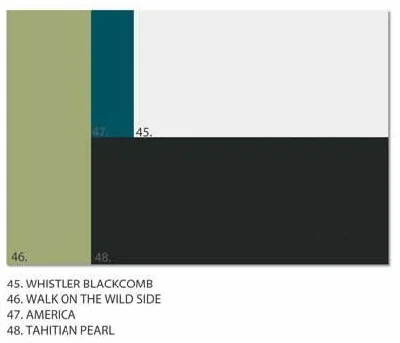
Paint colors created by Gillian C. Rose from her Color Our World™ Collection for Fine Paints of Europe

Paint colors created by Gillian C. Rose from her Color Our World™ Collection for Fine Paints of Europe
So this month I sat down with someone who thinks about color on a level most of us never do. Gillian C. Rose is a Color Scientist and the creator of the Color Our World™ Collection for Fine Paints of Europe. In her own words, she "trained in the application of color within the built environment and the human response." She gets at what we're drawn to through her specially-created Color Wordplay. As she put it to me, "I designed it to be like a Cosmo quiz, but in reality it's a neuroscience polarity test." Listen in.
Tammy: What is a color scientist? Gillian: A color scientist is someone who has studied the neuroscience of color — how we physiologically, psychologically, and cognitively respond to it. Color is a vibration, foremost. And it's an energy. There's a part of our brain called the hypothalamus. Our hypothalamus will tell us whether we are drawn to the vibration of a color or whether we are repelled by it. It is not cognitive, it is a physiological, biological reflex. We all have it.
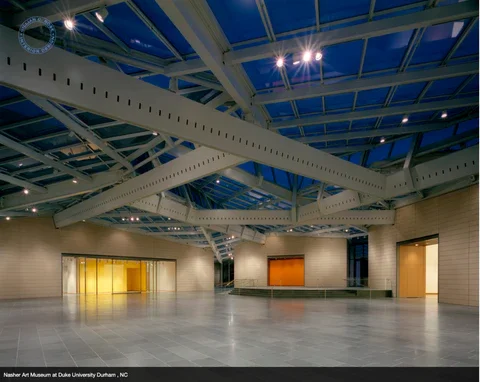
Nasher Art Museum at Duke University, Durham NC designed by Gillian C. Rose
Tammy: How do you use color to decorate? Gillian: Decoration is about people. It's all about creating an environment to support who is going to be in the space. It's really important to identify who the main people are, what the space is being used for, what time of day they spend in this home — it's literally creating support in every way you can.
Tammy: What is your favorite color? Gillian: My favorite color is emerald green. And I'm going to tell you something — I don't ask people their favorite color when I do a consult. I don't want to know. I couldn't sit in an emerald green room. When we're taught to think about color, we're taught about it as an object, something smaller than we are. Our environments are larger than we are, so it's not translatable.
Make it stand out
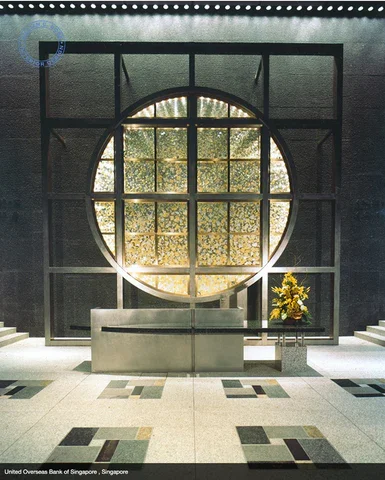
United Overseas Bank of Singapore designed by Gillian C. Rose
That last point of Gillian's is one I wish I could tattoo on the inside of every client's eyelids. The color you love on a handbag or a front door is not the color you necessarily want wrapping around you for twelve hours a day. A favorite color is a thing you look at. A wall color is a thing you live inside of. They are not the same job.
Here's how all of this plays out in my own work. I almost always start from the people and the light, exactly as Gillian describes — who lives here, how they want to feel when they walk in, and what the sun is doing to the room at the hours they actually use it. Then, more often than not, I build the envelope of a space out of complex, layered neutrals. A "white" that has a little something happening underneath it will telescope beautifully against the other tones in a room — the wood, the stone, the linen — in a way a flat, lifeless white never can. Those small shifts in depth and undertone are endlessly satisfying to the eye, even when no one can quite name why a room feels so calm.
That doesn't mean I'm afraid of color — far from it. I just like to spend it where it counts. A jewel-box powder room, a single saturated chair, a piece of art doing all the talking on an otherwise quiet wall. A little goes a remarkably long way, and a room that whispers will almost always outlast a room that shouts.
Color is feeling before it is anything else. Get the feeling right, and the paint chip practically chooses itself.
Best always in Creating Noble Spaces, Tammy and the Interior Archaeology Team